
Total hip replacement
Both the ball at the top of the thigh bone and the hip socket are replaced with artificial components. This is the most common form of hip replacement for advanced joint damage.
If hip pain, stiffness or reduced mobility is affecting your everyday life, waiting indefinitely for treatment can be difficult. MedTrip Poland helps patients living in Ireland explore private hip replacement treatment in Poland, with access to experienced orthopaedic specialists and support throughout the process.
You can send us details of your diagnosis, referral and any scans or medical reports you already have.
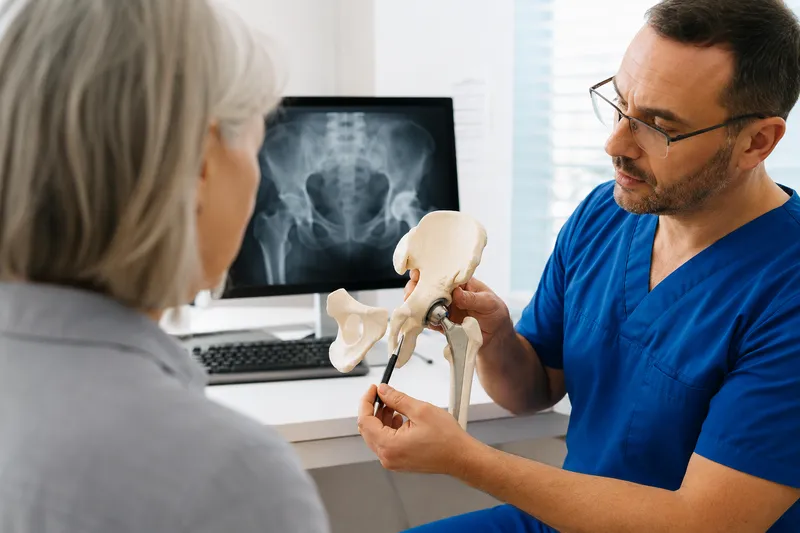
Hip replacement is commonly considered when damage to the joint causes persistent pain and reduced movement and other treatments are no longer providing sufficient relief.
During a total hip replacement, the damaged ball and socket of the hip joint are replaced with artificial components, commonly made from metal, ceramic or plastic.
Surgery may be recommended when hip pain, stiffness and loss of movement significantly affect everyday activities and conservative treatment has not provided enough relief.
Mobilisation normally begins soon after the operation. Recovery varies between patients and rehabilitation is an important part of regaining strength and mobility.
Long public hospital waiting lists can mean a significant delay before treatment. Private treatment in Poland may provide another option for patients who want to explore earlier access to an orthopaedic consultation and, where clinically appropriate, hip replacement surgery.
Source: National Treatment Purchase Fund (NTPF)Briefly tell us about your hip condition and where you are in the Irish healthcare system. If you already have a referral, X-ray, MRI or other medical documentation, you can let us know below. We can then discuss possible next steps and treatment options in Poland.
Hip replacement surgery is designed to replace the damaged parts of the hip joint with artificial components. In a total hip replacement, both the femoral head and the socket are replaced. The aim is to reduce pain, improve joint function and help restore mobility.
Both the ball at the top of the thigh bone and the hip socket are replaced with artificial components. This is the most common form of hip replacement for advanced joint damage.
In selected cases, only the femoral head and part of the upper thigh bone are replaced while the natural socket remains. The final choice depends on the individual condition.
Different implant systems can be used depending on bone quality, age, anatomy and the surgeon's assessment. The most suitable option is selected individually rather than using one implant type for every patient.
The implant is secured to the bone using surgical bone cement. This method may be considered where bone quality or other clinical factors make cemented fixation appropriate.
The implant is designed to allow the patient's bone to grow onto or into its surface, creating biological fixation over time.
A hybrid system combines cemented and uncemented components. For example, one part of the replacement may be cemented while another uses biological fixation.
Implant choice depends on the condition of the hip, bone quality, age, activity level and the surgeon's preferred surgical technique.
Some orthopaedic centres use muscle-sparing or minimally invasive approaches where clinically appropriate. The objective is to reach the hip joint while limiting unnecessary soft-tissue damage and supporting early rehabilitation.

Recovery begins in hospital and continues after discharge. Patients are normally encouraged to begin moving as soon as it is safe to do so. Physiotherapy is used to rebuild strength, improve movement and support a gradual return to everyday activity.
Standing and walking usually begin during the early post-operative period.
The length of stay depends on the surgical technique, general health and progress after surgery.
Exercises focus on strength, joint movement, balance and walking.
Recovery continues over the following weeks and months, depending on the individual patient.
Patients living in Ireland can explore private orthopaedic treatment in Poland rather than continuing to wait indefinitely for the next step. Medical records and available imaging can be reviewed before treatment arrangements are made, and the treating orthopaedic specialist decides whether hip replacement is clinically appropriate.
Review of symptoms, diagnosis, X-rays, MRI scans and existing records.
Information about the recommended procedure, expected stay and preparation.
Surgery and post-operative care are provided by the treating clinic in Poland.
Help with arranging the treatment process and required documentation.
Eligible healthcare received in another EU or EEA country may qualify for reimbursement under the HSE Cross-Border Directive, subject to the applicable HSE rules. Patients normally require an appropriate referral and must meet the relevant eligibility and documentation requirements.
Reimbursement is not automatic and the final decision is made by the HSE. The amount reimbursed cannot exceed the amount the HSE would normally pay for the same or equivalent treatment in Ireland.
Travel, accommodation and other non-medical expenses are generally not included in the reimbursement.
Tell us where you are in the treatment process and what medical documentation you already have. We can help you explore private hip replacement treatment options in Poland and explain the next steps.
Ask About Hip Replacement in Poland

